


Pocket-Sized Emergency First Aid Kits (For Your PFD)
HAVING A ROBUST RESCUE KIT AND FIRST AID KIT ARE IMPORTANT ITEMS FOR A RIVER TRIP OR A SWIFTWATER TEAM TO HAVE.
But what do you do when you find yourself separated from your primary kit in your boat or vehicle? Over the years we have found that having a small kit with basic items can make the difference when you are caring for yourself or others on the side of the river. These suggestions come from personal experience and the experience of others who had to care for themself or others while away from their main supplies. Having these when things go wrong can make a huge difference until the larger emergency kit can arrive.
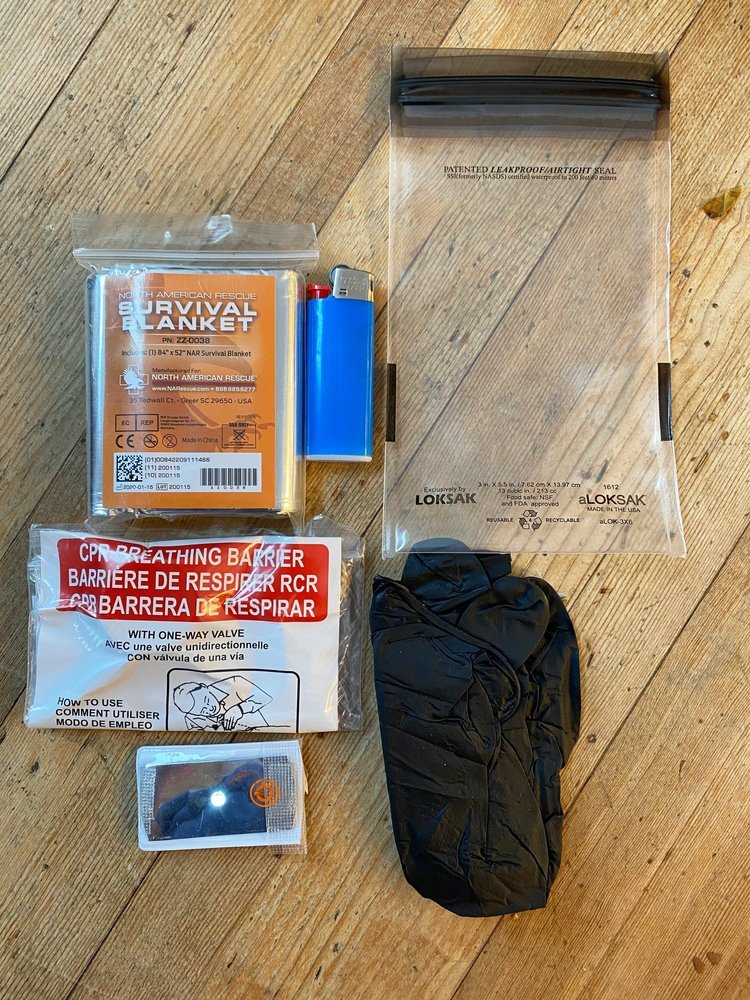
This pocket sized emergency first aid kit includes crucial items needed to begin administering care if you find yourself separated from your full first aid kit. It’s an excellent item to have on hand for river-runners or rescue teams.
Emergency Blankets have a great amount of tensile strength allowing them to be used for a variety of uses. These include: shelter for yourself or a non-mobile patient from wind and rain, creating an improvised sling and/or swath for shoulder/elbow injuries, a pelvic binder for unstable pelvic injuries, making ties for splinting, an improvised tourniquet, and many more uses.
Small CPR Barrier: While this type of CPR barrier is not the ideal, it is one you can carry with you everywhere. With water sports having a higher incidence of drowning, having a barrier device with you can protect you while you give immediate life saving rescue breaths while someone else works on bringing a full size CPR pocket mask from your larger first aid kit.
Disposable Gloves, of course, do the obvious job of keeping things that are wet and sticky and not your own, off of you. Having gloves on makes it easier to get over your squeamishness and quickly apply direct pressure to a wound while preventing the transfer of pathogens from one person to another.
Fire Source Bic Lighters are one of the most reliable lighters we have come across. Even if they get wet they will still spark after a few good blasts of air on the flint and striker. They can provide a spark to alert others to your location in the dark and provide a fire source to provide light and heat in the dark.
Fire starter in the form of a small bit of rubber for fire starting, will light and stay lit even in terrible weather, allowing you to build a fire for heat and mental comfort. We find a couple of strips of an old bike tube work well.
Light Source Small Disposable LED Lights provide the obvious light you need if benighted and it can be a huge help when caring for yourself or a patient. Additionally, they provide a way to signal and be seen by those who are coming to your aid.
Waterproof Container: We have had great luck with ALOKSAK bags. These storage and transport dry bags are guaranteed to be waterproof and have been certified to 60 meters for over 2 weeks. Leakproof, double-zipper products offer unparalleled water-tightness in a reclosable bag. Durable 6 mil film has a “cold-crack” tolerance to -40F/-40 C, Far lower than that of PVC or Vinyl.
We are huge proponents of everyone carrying these and the 3:2:1 or 4:3:2:1 system on their person. Doing so takes very little room in your PFD, but provides huge benefits to yourself and the group in the event of an emergency.
Feel free to utilize this list to make your own personal kit or purchase a fully stocked kit from us.
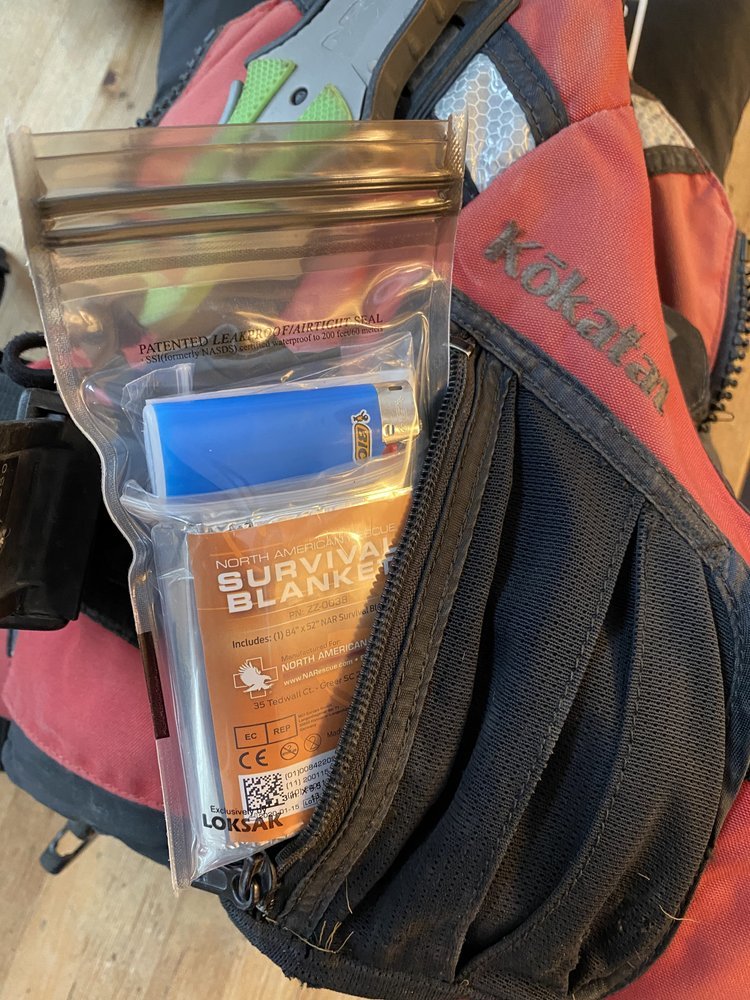
Packed properly, this pocket-sized emergency first aid kit fits into the front pocket of your PFD.

Swiftwater Skills and Professionalism
Safety and preparedness provide confidence in a guide, and a confident guide is a successful guide. This is why it is important for guides to be swift water or river rescue certified, so that they can learn to manage a scenario on their own as well as with a team, analyzing the situation from a variety of perspectives and gaining hands-on experience of crucial skills.
PROFESSIONAL GUIDES NEED SWIFTWATER INSTRUCTION
As a professional guide, you don’t want your first emergency encounter and comprehensive rescue to feel like a situation you’ve never come close to experiencing, and you certainly don’t want to cause further harm due to a lack of knowledge. In that instant, you want to realize that you’ve seen something like the predicament in a swiftwater rescue scenario, and you want to understand how to initiate the rescue process. Swiftwater rescue scenarios are purposefully realistic in order to prepare for the physical aspect of dealing with an emergency as well as the mental exhaustion and emotional toll that a traumatic crisis can cause. Safety and preparedness provide confidence in a guide, and a confident guide is a successful guide. This is why it is important for guides to be swiftwater or river rescue certified, so that they can learn to manage a scenario on their own as well as with a team, analyzing the situation from a variety of perspectives and gaining hands-on experience of crucial skills. When guiding on the river, you might never encounter even the tamest of scenarios practiced in your swiftwater course, but it is professional and responsible to be prepared for the wildest of emergencies.
RECERTIFY YOUR SKILLS ON A REGULAR BASIS
Because of the rarity of extreme catastrophes on the river among well-trained guides, it is imperative to recertify your Swiftwater Rescue or River Rescue course when the time comes. This course is often the only time you are faced with the worst of the worst situations. Complacency is dangerous for an active guide, because certain skills, such as knot tying and creating z-drags, are easily forgotten if not consistently practiced. One of the last situations you want to find yourself in is struggling with pulleys on shore to create a strong enough mechanical advantage to unpin a boat while passengers are trapped atop the raft. Refreshing these practical skills in a recertification course will also introduce you to other guides and new mentors, as well as the new technology and methodology that crops up every couple of years as advances are made in the rescue world. Continuing education also leads to advances in your field and towards becoming an expert within the community.
During a swiftwater recertification course, you will have the chance to discuss and reenact actual emergency situations you or others have been involved in since your first course. In that safe and controlled environment, you can analyze your past response and learn what could have happened differently if certain factors were changed. You will surprise yourself with forgotten skills that might have been game-changers in the original scenario! The development of muscle memory and the repetition of unique rescue skills can help your response become immediate and second nature the moment a crisis arises. An expert handling of gear comes with patience and practice, and is essential when a high stress predicament occurs so that you can trust your hands to do the work on their own.
MY SWIFTWATER TOOL KIT
As a professional raft guide, there are certain pieces of gear that never leave my PFD. Strapped to a shoulder strap is my whistle, easy to sound without having to fumble with zippers. Also attached to outer fastenings are my four carabiners I use to secure my boat at night, connect boats to one another, and create Z-drags. Within the chest pocket of my PFD I keep practical personal items, such as sunscreen and lip balm, extra sunglass croakies, a waterproof notebook with river and WFR notes, and my flip line. I also somehow manage to store prusik cords and two pulleys in the same pocket to enhance the mechanical advantage of the Z-drag systems I can create. A convenient standard to follow when selecting gear for your PFD is the 4-3-2-1 system - four carabiners, three prusik cords, two pulleys, and one piece of webbing or a flip line. With these pieces of gear you can build a simple and adaptable 3:1 mechanical advantage system to aid with almost any boat pin or flip, and you can conveniently complete a myriad of other more basic tasks. The last items that can be found in my PFD are stray bits of trash that I’ve recovered from various lunch beaches or campsites along the river, easy to discard once at camp or the ramp. Micro trash is a macro problem! This may seem like an excessive amount of gear to have on hand in a PFD, but once you master the use of this gear, rafting and rescues become infinitely more straightforward.

LESSONS LEARNED ON THE RIVER
As you will learn with experience, straightforwardness is to be desired in any rescue attempt. But, as you will also come to realize, the ever-evolving characteristics of nature define any outdoor scenario, and complications are more likely to arise than easier paths. On my first trip down the fabled Grand Canyon, our group of sixteen consisted of experienced river guides as well as passionate private boaters. We were confident in our combined rafting and rescue skills and of our ability to assess the risk of every scenario and make the safest calls. It was a winter trip, with clear but cold weather and short days with little sunlight deep in the canyon. We approached Crystal Rapid at mile 98 in the late afternoon, hoping to run the rapid and camp directly afterwards. We scouted the rapid from high above and from the shoreline, sensing the building anticipation as we observed the mess of whitewater from every angle available. As a group, we decided the best course of action was to hug the right shore, pulling away from the notorious mid-river hole and skirting the majority of the rapid to make it to camp just below the nastiest of the waves. The sun had long since dipped below the rim of the canyon walls and we knew night followed swiftly. It was imperative that we made it to the mid-rapid camp, as there was just one more camp after Crystal before the rest of the Gems - a series of large and exciting rapids that closely followed one another and would best be run in the light of a new day.
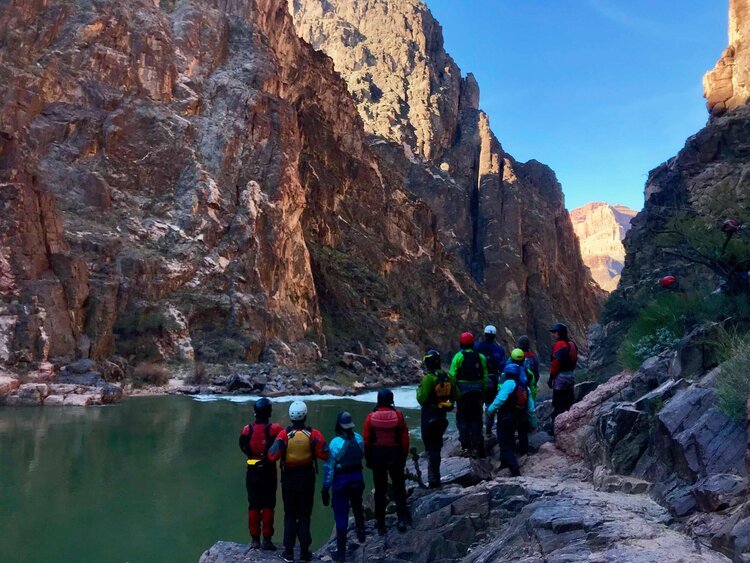
I was among the first boats to push off from shore and float anxiously towards the roar of Crystal Rapid, eagerly searching for my pre-specified marker rocks that told me when to make critical moves. Three boats and one stand-up-paddleboard managed to skirt the recirculating hole and make it to camp, but not without extreme effort - the maneuver was much more difficult than we anticipated as the majority of the current ran directly into the hole. I pulled my boat to shore and was just about to secure it when I watched the next boat float into the hole sideways and flip, spilling both its passenger and guide into the current. The following boat, one of our monster 18-foot gear haulers, was close behind and met the same fate. Within seconds we had two flipped boats and three swimmers in the frigid waters of the Colorado River. The rest of us were quick and efficient in our rescue, as several of us are Swiftwater trained, and we retrieved the swimmers within a minute and had the boats to shore directly after the rapid. Little time was lost, but we were left with fading daylight and one option for camp before the Gems. The current was fast and the eddy line was strong and resistant, making the move into Tuna Camp particularly difficult. Half of us made it into the choppy eddy and watched as one of our group members pulled on her oars to no avail and was carried past the camp, into the first of the Gems.
We were exhausted and frustrated, running on expired adrenaline and forced into a series of massive rapids that we had no chance to scout or read about in our guide books. It was dusk and the next camp wasn’t for several miles. By the time we made it, we were dangerously cold and utterly spent. It had been a calculated risk to run Crystal Rapid at that late hour, and we assumed too much of ourselves and too little of the power of the river. It was a situation that escalated quickly and led to even further endangerment. We should have prepared for the worst and camped above Crystal. This was a situation in which over-preparedness and extreme caution would have prevented the spiraling scenario that followed instead.
A professional attitude is the best way to navigate real-life emergencies involving any kind of passengers, especially if friends or family are included. Once an accident occurs, more are likely to follow in response to elevated emotions, high adrenaline and rushed reactions. A composed, level-headed, and clear head space provides separation from distractions and emotions that can be overwhelming.

This past summer, I was lucky enough to join a group on a trip down the Selway River in Idaho. Thirteen of us set out in thirteen inflatable kayaks fully loaded with gear. The Selway is famous for its beauty and its whitewater, as we quickly came to realize. Within the first two days, most everyone in our group capsized and swam in multiple rapids. The only ones who hadn’t swam were myself and two others as we approached the most notoriously difficult stretch of whitewater on the Selway. We scouted the first of the class IV rapids, named Wa-poots, that came around a sharp bend just before the biggest of the rapids in the section, Ladle. Our lead boater was one of the few who hadn’t yet swam from his boat up until that moment - he was caught by a surprise lateral wave and swam the entirety of Wa-poots. Following him was our trip leader and permit holder who had no previous rafting experience. He was able to rescue the swimmer but unable to retrieve the boat, and one of our inflatable kayaks floated into Ladle and out of sight. We had two more swimmers in Wa-poots, but were able to ferry the people and their boats to shore before the next rapid.
Along the Selway is a trail that is used by hikers and by boaters to help scout the rapids. We hiked to several different vantage points above Ladle and the outlook was the same - the field of house- and car-sized boulders that lay strewn in the river could hardly be envisioned as a readily runnable rapid, and our stray boat had found its way to the dead center of the mess. At this point, we made a conscious effort to step back, weigh options, create a dependable and step-by-step plan, and accept or reject certain consequences. We decided that we would make our best effort to rescue the pinned boat, but also acknowledge the fact that we would not take any risks too drastic in such an effort. People are more important than gear, even in the case of an entire boat, and no one should ever risk their life to unpin a boat. Having scouted and discussed every viable line in the rapid, half us headed back to our boats to run the rapid. The other half were setting safety and watching to see if our chosen line - far left and partially out sight - was the best choice. Our trip leader (TL) who had failed to retrieve the boat initially was with the first group and had been frustrated with himself and was rather worked up. In his distracted state of mind, he stumbled and fell while rigging his boat. I looked up from my preparations to see another unmanned boat floating innocently into Ladle. It looped around the first giant boulder and disappeared from sight.
We found our TL in shock and in pain - he had fallen on his wrist and was shaking with pain and exasperation. The situation had just become immensely more complicated because one of our group members had let emotion get to his head and he was now injured and boat-less. He must have had a wealth of unused river karma, because his boat had tucked itself in a small eddy between two giant boulders above the rapid and was patiently waiting there. We sent three people in two boats to the larger of the boulders and they lowered one person via throwbag to the expectant raft. The three rescuers then paddled back around the boulder safely to shore. At this point, we had been above the rapid for well over an hour and not one boat had even attempted to run it with a person on board. Four of us, myself in the lead, took the left line and ran Ladle. The last two pinned on a boulder at the bottom of the rapid and both swam, making it to shore just a few feet from their pinned boats. One boat came un-pinned and they were able to grab it in time. The rest of the group was on the right side of the river discussing our plan, watching as two of our group members attempted to rescue the most recent of our boulder-pinned boats. This took at least another twenty minutes of arm-in-arm wading across currents, throwing ropes, and shouting matches. At one point I noticed that there was no longer a boat stuck on a rock in the river, but a person in its place. Our day was devolving quickly as emotions became strained and further predicaments followed. The group had become separated on different shores, and those of us on the right side were left with the original task of retrieving the mid-stream raft.
Three people launched and took a different line down the middle of the rapid, quickly paddling into small eddies behind rocks to make their way safely to several rocks just above the pinned boat. What we hoped would be an easy rescue turned into three more hours. We were hot, dehydrated, hungry, aggravated and downtrodden as we watched attempt after failed attempt to free the mysteriously pinned raft. As five o’clock approached we gave our crew of mid-river rescuers another half hour before we would have to abandon the boat and continue downriver. We had only made it two miles since pushing off that morning and had several more class IV rapids to run directly downstream. Only four boats had made it through Ladle at that point, and due to his injury our TL felt unable to paddle confidently. I led the second group of five down the left line in his boat, with no further swimmers or pins. At 5:30, twelve boats continued past Ladle, having abandoned the unlucky thirteenth.

Our day at Ladle was the most intense and complicated river situation I have been involved in, and a majority of the crises stemmed from elevated emotions and rushed reactions. We did well in making a clear, concise, and safe plan of action, thinking critically and rationally, but realized that even the best laid plan can be led astray when emotion and adrenaline run rampant. I was incredibly appreciative of the fact that myself and three others had had swiftwater training and were able to lead the group to the best possible outcome of a worst-case scenario. It was our professional skills and clear-headed mentalities that saved the day.
For more information on River Rescue courses for professional river guides and recreational river runners, see our list of available course dates and schedule an open course for yourself, or a private group course for your organization or business.
For more information on Swiftwater Rescue courses for professional rescuers, see our list of available course dates and schedule an open course for yourself, or a private group course for your organization or business.
Blog content provided by guest author and professional river guide, Bridget Guthrie, (RRC).
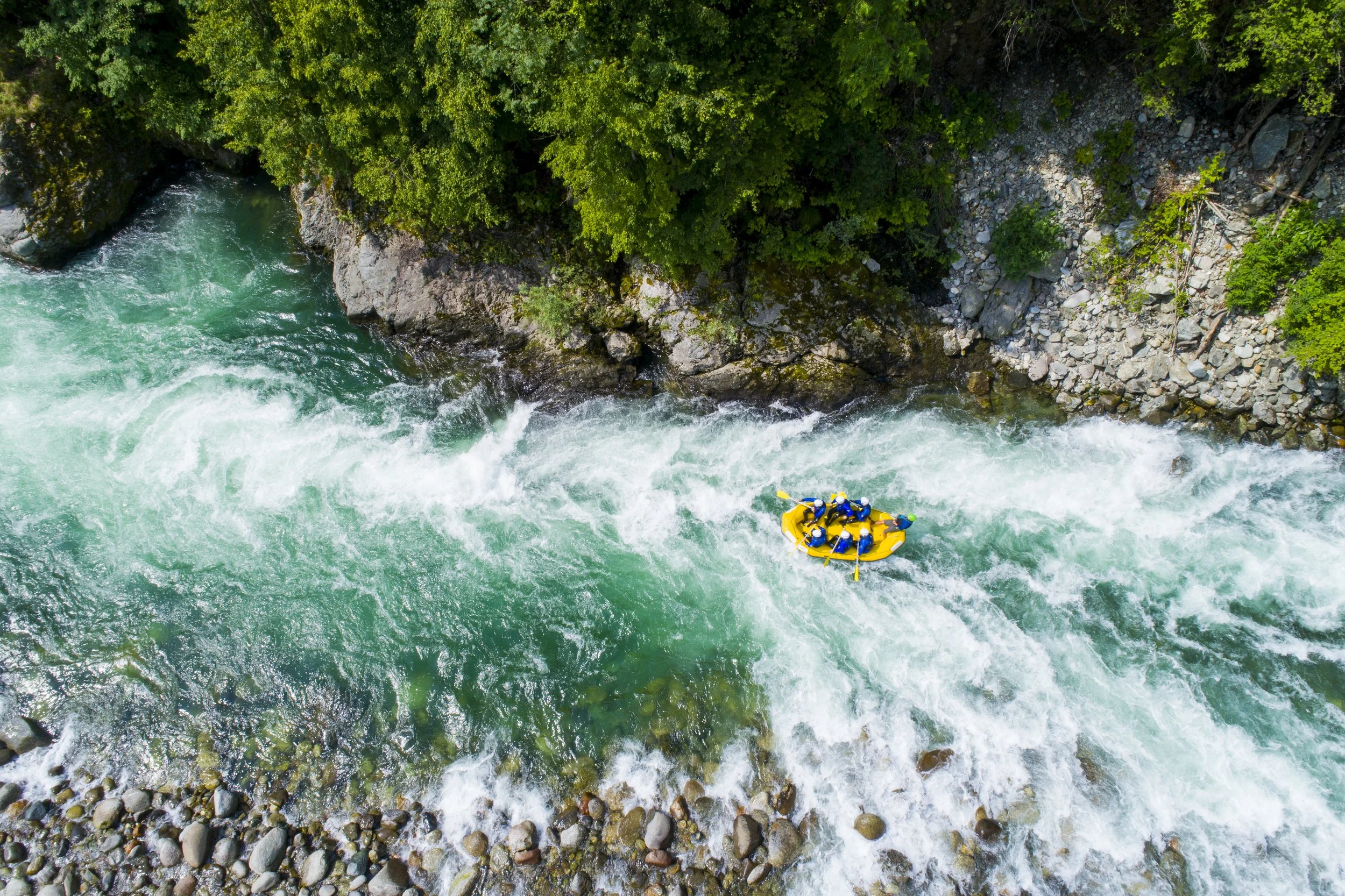
Why Every River Guide Needs Swiftwater Rescue
Rafting is meant to be challenging, exhilarating, and immensely rewarding, especially on such a day when your time on the water is uncomplicated. But, as any guide or outdoor enthusiast can attest, the realities of the river tend to be much more complex than simply having a good day or a bad day, and can wholly depend on how prepared the guide is to adapt to the circumstances that unfold.
EVERY GUIDE SHOULD TAKE A SWIFTWATER COURSE
If a river guide was to imagine their perfect day on the water, it would likely include a cloudless sky, a balmy tailwind, an enthusiastic group and exciting conditions on the river. All involved would end their day extremely satisfied having experienced the ultimate river trip. Rafting is meant to be challenging, exhilarating, and immensely rewarding, especially on such a day when your time on the water is uncomplicated. But, as any guide or outdoor enthusiast can attest, the realities of the river tend to be much more complex than simply having a good day or a bad day, and can wholly depend on how prepared the guide is to adapt to the circumstances that unfold.
A significant factor of becoming a successful guide is self-assurance - in conversations with guests, in the credibility of information shared, and in the ability to navigate the river. A Swiftwater Rescue course is the surest way to gain confidence in understanding the river technically. Because of all that guides stand to gain from such a course, there is certainly a significant amount of work to be expected from the two or three days spent paddling boats, throwing ropes, swimming across currents, and performing mid-river rescues. Depending on the time of year, participants could be carrying out such tasks in the freezing rain or snow of spring, or in the blistering heat of a late summer course. Environment and weather play a huge role in most emergency situations on the river, so being prepared for coursework in a variety of conditions is a relevant first lesson of a swiftwater or river rescue course.
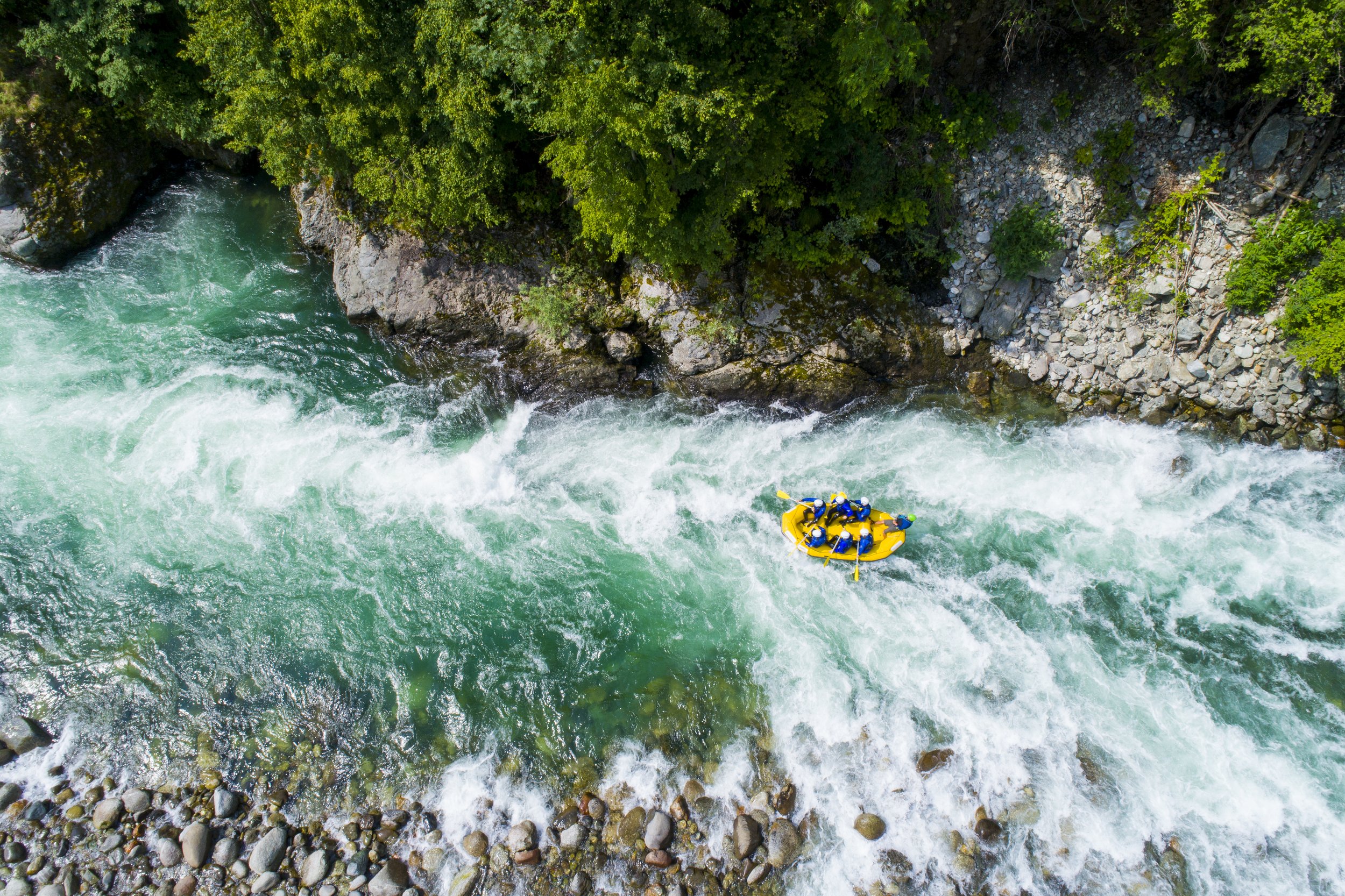
Every day on the river is a good day, but rafting is not without risk. Swiftwater rescue teaches you to anticipate, prepare, prevent and react.
WHAT TO EXPECT
Before the course even begins, participants will likely be contacted by their instructors with information on what to bring, what to expect, and some pre-course reading material. As the course continues, expect the work to continue at home with scenarios to research and knots to practice. This should not be thought of as homework - expect to be taught by instructors who are experts in their fields and be sure to appreciate the wisdom they are willing to share. Participants should be ready to receive a flood of information and to be mentally exhausted by the end of the course! This is a particularly relevant lesson in swiftwater instruction that is taught intentionally - some of the worst situations on the river will be difficult to cope with as a guide or first responder, and mental exhaustion goes hand in hand with an intense rescue. It’s a great idea to write down a page or two of notes at the end of each day to help digest and remember such information.
Swiftwater courses usually involve around a dozen participants from different guiding backgrounds alongside recreational rafters looking to be well-educated for personal trips. Because of this, many of the scenarios involve multiple people in varying states of distress, such as a mid-river foot entrapment combined with a flipped raft and several swimmers, leading to a boat pin that involves ropes and pulleys. These situations can take hours to deal with, and even longer when participants must learn the intricacies of ropes systems and take turns rescuing others. Expect to be in and around the water for hours at a time and in a constant state of dampness, which could get uncomfortable if not otherwise prepared. There will certainly be excitement throughout the course as participants will get the chance to swim whitewater, attempt to scramble over strainers, and haul others back to shore while on live bait.
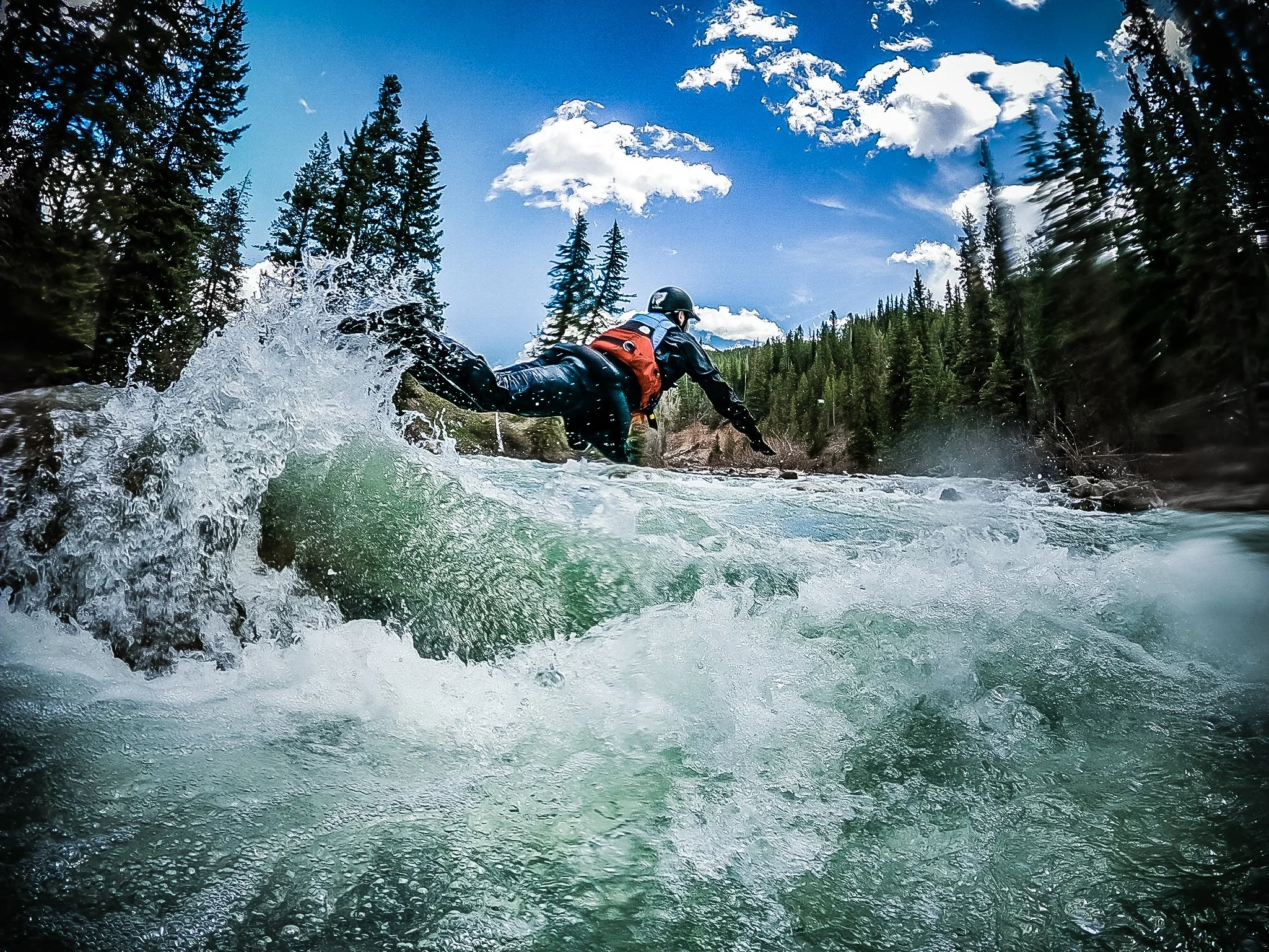
A river rescue student prepares to jump into a rapid on the Snake River in Jackson, WY.
Boaters of all experience levels will partake in Swiftwater Rescue courses, but the experience is fundamental for new guides. What the course doesn’t cover are the nuances of guiding - creating meaningful connections with guests on the boat and instilling in them an appreciation for their surroundings. First year guides will undoubtedly make mistakes in the beginning, such as flipping boats, missing a rapid, floating down the wrong channel, or getting a boat pinned. Whatever the situation, the passengers will be paying attention to how the guide reacts and what their response entails. A swiftwater-trained guide will have the tools for appropriate action with a cool head and an organized thought process. New guides are rarely alone on the river, and can therefore trust in the assistance of fellow guides who have had similar training, are eager to help, and have likely made the same mistakes before. Their feedback will be essential in alleviating mistakes and making certain the situation will not be repeated. Guides love to talk about their wildest rescues and their most terrific mishaps, anecdotes that are sure to be entertaining as well as informational!
THE BEST ADVICE FOR FIRST TIME GUIDES
One of the most efficient ways to combat mistakes is to practice and gain experience, and this means taking any and all trips that are offered. New guides often have to work their way up the ladder within their guiding community, meaning that any work is beneficial. The first several rafting trips a guide embarks upon with paying passengers will be full of anticipation. It is important to remember that the guests are also embarking on a completely foreign adventure, and they are placing their trust in their guide’s hands. The title of river guide is inherently impressive, and guests will admire their leader from the start. Instead of channeling nervousness, channel the excitement of the guests and let that energy carry the journey. Managing the elements that are controllable, such as the temperament on the boat and the safety of the passengers, is crucial, because most other conditions will be completely out of the guide’s control. Be able to give an enjoyable trip despite inconvenient conditions that might arise along the way, such as a sudden rainstorm, a nasty headwind, or difficult guests. No matter the circumstances, guides will be navigating familiar waters, and must grow accustomed to the repetition of safety speeches, facts along the river, favorite jokes, and critical maneuvers.
New guides should experiment with how they present themselves to different groups - are the passengers more interested in constant and engaging information about the area, or are they more interested in a relaxed atmosphere? Gauging the expectations of the passengers is just as important as reading the river. Effective communication follows thorough research - the more prepared a guide is with knowledge about where they live and work, the more dynamic their trips become. Interactions on the river can also include encounters with guides from other companies as well as river rangers. Guiding involves entertainment and excitement, but also requires a worthy amount of professionalism and customer service. There is a distinct community among river-users, and it is founded on respect for the river and its unpredictability. Rafting should not be about who takes the riskiest line through a rapid, or who has the most enviable gear, but about sharing, valuing, and protecting the natural beauty and power of the river environment.

Students test their swift water skills in order to earn their river rescue certification in an all women’s swiftwater course in Jackson, WY.
One of the greatest features of the river is that it can do the work for the guide. A huge struggle for new guides is that they tend to work against the river in an attempt to be in command, and end up working harder than they need to. Learning to read the river and ceding a measure of control to the current are indispensable skills that guides need to develop through patience and practice. Once mastered, the guide will barely have to dip their oars in the water for a trip to run smoothly, allowing more energy to be devoted to the passengers along for the ride. It is important to know when to take charge and captain the boat forcefully in certain situations, and physical fitness is still a vital part of guiding. Long days on the river call for endurance and stamina. New guides will quickly realize that life on the river is a balancing act - a constant effort to provide an excellent trip that is both exciting and safe. Putting all the elements together requires high energy, enthusiastic engagement with the passengers, a little bit of eccentricity, and a thorough knowledge of prevention and response.
For more information on River Rescue courses for professional river guides, see our list of available course dates and schedule an open course for yourself, or a private group course for your organization or business.
For more information on Swiftwater Rescue courses for professional rescuers, see our list of available course dates and schedule an open course for yourself, or a private group course for your organization or business.

Featured Podcast: The Role of the Responder
This is an interesting podcast about those people who are on scene at the time of an incident. They may be trained professionals on a day off or guides who are on scene when an accident occurs.
This is an interesting podcast about those people who are on scene at the time of an incident. They may be trained professionals on a day off or guides who are on scene when an accident occurs.

MCI, Rope Rescue & Triage
This is a great podcast episode about an MCI, Rope Rescue and Triage. We are lucky to be able to work with Dr Will Smith on the SAR team and he does a great job talking through this emergency response.
This is a great podcast episode about an MCI, Rope Rescue and Triage. We are lucky to be able to work with Dr Will Smith on the local SAR team and he does a great job talking through this emergency response.

Guide or Rescuer, This Applies to All of Us
One of the best pieces of advice I’ve gotten in this sport was to “be a proud, humble badass.”
While reading an article online I came across this paragraph and felt like it was relevant to not only the guides it is written to but to professional rescuers as well:
"From the moment we start strapping rafts onto the bus, we become scientists. Every second has a problem that needs solving. Every rapid has its own variables that we must take into account to lead us to a clean line. We analyze the situations before us, apply knowledge gained through experimentation, and execute hundreds of times per trip. We’re rockstars when we pull off a great trip and we should know that, but success should never give us a false sense of control over the river.
One of the best pieces of advice I’ve gotten in this sport was to “be a proud, humble badass.” The example I thought of was Bruce Lee who once said, “Knowledge gives you power, but character, respect.” What we do is dangerous and difficult and requires a tremendous amount of respect. We must always strive to further our knowledge so that we have the power to lay down stomping lines. But we must have the strength of character to know our limits and respect the dangers of dancing with the awesome physical forces of nature."
Read the rest of the article HERE

Drywear Gear Care
Drysuits, drytops and dry pants provide excellent thermal protection when in cold water. They are some of your more expensive boating attire; taking good care of them protects your investment and ensures they’re in good condition when you need them.
Now is a good time of year to take care of and repair any of your gear but especially your expensive dry gear. Latex gaskets do not do well without a little love and 303. NRS has published some great guidelines for drywear gear care we wanted to share:
Drysuits, drytops and dry pants provide excellent thermal protection when in cold water. They are some of your more expensive boating attire; taking good care of them protects your investment and ensures they’re in good condition when you need them.
SAFETY CONSIDERATIONS
Replace any damaged or torn gaskets and socks before use.
With your drysuit, make sure all dry zippers are fully closed before boating. Remove excess air from the suit (“burp”) before paddling and after opening or closing a zipper. To burp the suit, squat while holding the neck gasket open to expel air; then release the gasket. You can also enter the water and let water pressure force out air while holding the gasket open.
Getting in the water before each boating session is an excellent safety habit to adopt. This will not only help you burp the suit, it can also disclose a problem like—heaven forbid—an improperly closed zipper!
Excess air in the suit can make it difficult or impossible to escape certain hydraulic features. However, over-burping the suit will fully compress your inner layers and impede their insulating value. As with most things in life, balance is a good thing.
GASKET CARE
New latex gaskets may not be comfortable initially, but they will stretch over time. You can speed up the stretching process by placing something slightly larger than your neck, wrist or ankle in the gasket and leaving it overnight (or longer, if necessary).
Trimming the gasket is not recommended and may cause gasket failure.
Sunscreen, insect repellant and other chemicals can damage latex. Clean gaskets after each use and regularly apply 303 Protectant.
Be careful of rings, earrings, watches and other sharp objects when donning and removing your dry wear.
Do not force your body, especially your head, through the gaskets. Gently stretch them open as you put on and take off the garment.
Even with the best of care, gaskets will eventually break down and need to be replaced. The How to Repair Dry Wear Gaskets video demonstrates do-it-yourself steps. There are also written Gasket Replacement Instructions. Replacing your own gaskets isn’t hard and is a valuable boater skill. Our experienced folks in the NRS Repair Department can also replace gaskets at a reasonable cost.
ZIPPER CARE
Avoid bending or crimping a dry zipper. A broken zipper cannot be repaired, and replacing one is very expensive.
When closing a zipper, line up the two halves and slide the zipper car with a smooth, steady motion. If you have difficulty, stop and determine the cause. You may need to ask for help.
Use products like McNett Zip Care and McNett Zip Tech to clean and lubricate zippers. This will help them operate much more smoothly and make them less subject to damage. Placing a bit of Zip Tech in the closing end will help improve the seal.
Never force a zipper. When having difficulty, inspect the zipper, clean out any obstructions and lubricate the zipper teeth. Closing a zipper over a piece of debris can ruin the zipper.
DRY WEAR TRANSPORTATION
Keep garments out of direct sun, and avoid leaving them in closed, hot vehicles. Sun damages gaskets and heat can affect seam taping.
Special care must be taken when transporting your drysuit to avoid damaging the zippers. Fold or roll the suit so the zippers are not bent or kinked. Ensure that no heavy objects are placed on top of the rolled suit. The Drysuit Zipper Care and Maintenance video demonstrates good folding techniques, as well as how to clean and lubricate the zippers.
DRY WEAR CLEANING
It’s a good idea to rinse your dry wear in fresh water after use, especially if you’re boating in silty water or seawater.
If more thorough cleaning is needed, use a product that is designed for technical outerwear garments. We recommend products like ReviveX Synthetic Fabric Cleaner or Nikwax Tech Wash. Closely follow cleaner directions.
Do not use liquid laundry detergents, bleach or harsh chemicals on garments.
We recommend hand washing and rinsing. Air dry garments; never put them in a clothes dryer.
RESTORING DURABLE WATER REPELLENT (DWR)
Dry wear fabrics are given a DWR treatment by the manufacturer, so water beads up on the surface rather than soaking into the fibers and interfering with breathability. This treatment is long lasting but eventually abrasion and soiling will overpower it, leading to “wetting out” of the fabric.
Sometimes just washing away soiling on the garment with cleaners like ReviveX Synthetic Fabric Cleaner or Nikwax Tech Wash will restore the DWR. If this does not work, you have not wasted a step; it’s necessary to clean the garment before using a DWR-restoring treatment.
There are a number of good DWR replacement treatments available. We recommend 303 High Tech Fabric Guard, ReviveX Spray-On, Nikwax Direct Wash-in and Nikwax Direct Spray-On. Closely follow directions.
DRY WEAR STORAGE
Dry garments thoroughly before storage.
Store them out of direct sunlight in cool, dry conditions.
Store drysuits with plastic TIZIP® zippers fully closed. Store suits with metal zippers with zippers open.
Do not store them in rooms with combustion sources, such as a furnace room; they can generate ozone, which damages latex.
Treat gaskets with 303 Protectant before storage.
Hang or loosely roll garments.
Avoid high heat and humidity.

The Rescue Blog
We teach a wide group of practitioners including River Guides, Government Employees, Scientists, Search and Rescue, Fire and EMS, Industry workers as well as many others seeking technical rescue instruction.
We are excited to be launching a new blog! We hope to feature lessons learned, current rescue incidents as well as articles that provoke thinking about rescues. We teach a wide group of practitioners including River Guides, Government Employees, Scientists, Search and Rescue, Fire and EMS, Industry workers as well as many others seeking technical rescue instruction.
Because of the range of the audience, we will post a variety of content however in many ways, it all relates to each other. Our hope is that you will be able to glean the nuggets of information that relate to you in your field as well as learn about and from other disciplines. In doing so you will further yourself as a professional and will be able to better contribute to the field of technical rescue.
Thanks for joining us!